
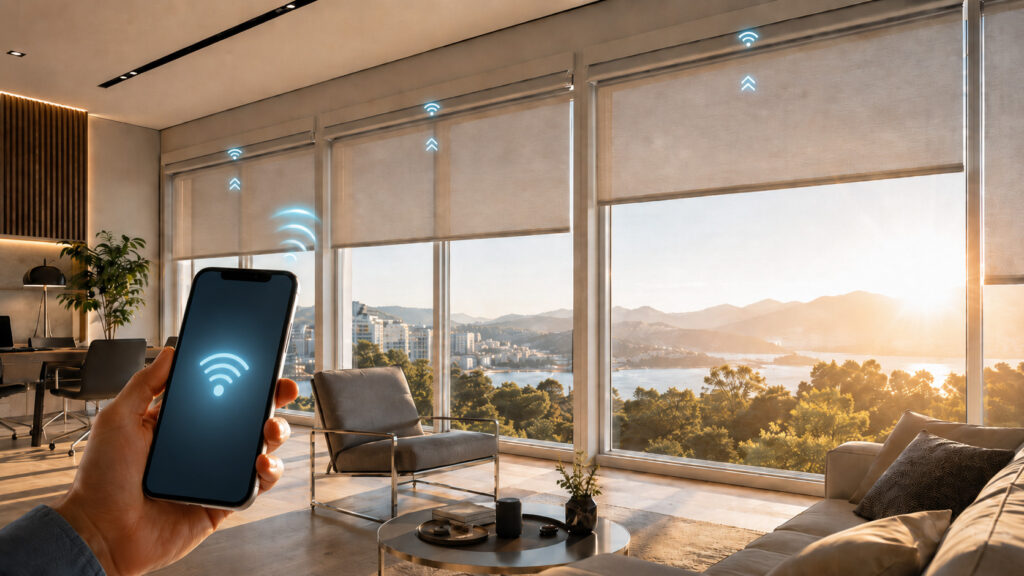
While motorized blinds for windows are made easier to operate, an automated blind takes it to the next level. By integrating an Internet of Things or IoT system to the motorized blinds, users can control and automate their blinds based on schedules, sunlight, temperature and other conditions.
What Is the Difference Between Motorized and Automated Blinds?
A motorised blind uses a motor to open or close the blind. A remote-control, wall-switch or other control device may be used for operating it instead of pulling a cord.
Automated blinds on the other hand can run independently of a person controlling them at any given time. When connected to an IoT or smart control system, the blinds can respond automatically to selected settings or environmental conditions.
For instance, the blinds can be programmed to retract at 7am to let in natural sunlight and extend again at 7pm to provide greater privacy in the evening.
|
Feature |
Motorised Blinds |
IoT System Integrated Blinds |
|---|---|---|
|
Basic operation |
Opens and closes using a motor |
Opens and closes using a motor with connected smart controls |
|
Control method |
Remote control or wall switch |
Mobile app voice control smart-home system or BMS |
|
Scheduling |
Usually requires manual operation unless a timer is added |
Can be programmed to open or close automatically at specific times |
|
Sensor integration |
Limited unless additional controls are installed |
Can respond to sunlight temperature or other connected sensors |
|
Remote access |
Generally limited to nearby controls |
Can be controlled remotely through an internet-connected system |
|
Automation |
Motorised movement does not necessarily mean automatic operation |
Can operate automatically based on schedules or preset conditions |
|
Smart-home integration |
May not be connected to other devices |
Can integrate with compatible smart-home platforms and connected devices |
|
Commercial use |
Suitable for individual rooms or windows |
Suitable for centralised control across multiple areas or a building |
|
Best suited for |
Users who want convenient powered blind operation |
Users who want connected automated and centrally controlled blinds |
How Does IoT Automate Motorized Blinds?
When a motorised blind is connected to a smart-home or building system, it can communicate with other devices and controls within the system.
Depending on the system setup, users may be able to:
- Open and close blinds remotely through a mobile app
- Use voice commands through Google Home, Alexa or Siri
- Schedule blinds to operate at specific times
- Use light sensors to adjust blinds according to sunlight
- Use temperature sensors to reduce heat entering a space
- Integrate blinds with other smart-home devices
Instead of manually adjusting each blind throughout the day, the system can manage the blinds automatically based on predefined conditions.
How Can Automated Blinds Work in Commercial Buildings?
IoT-enabled motorized blinds for windows can also be integrated with a Building Management System or BMS.
This allows building managers to centrally manage multiple blinds across offices, meeting rooms and other areas.
For example, blinds can automatically adjust when sunlight becomes too strong or when indoor temperatures rise. Building-wide schedules can also be set to create more consistent shading throughout the day.
From Motorisation to Smart Automation
Motorisation offers the physical means to move a blind but IoT gives intelligence and connectivity to make it automatic.
By connecting motorized window shades to smart controls, sensors and scheduling systems, property owners can create automated blinds that respond to how a home or building is actually being used.
Maxtrack offers motorisation and automation solutions for residential and commercial window shading, which allow customers to upgrade from manual window shading to the next level of intelligent and connected blind management.